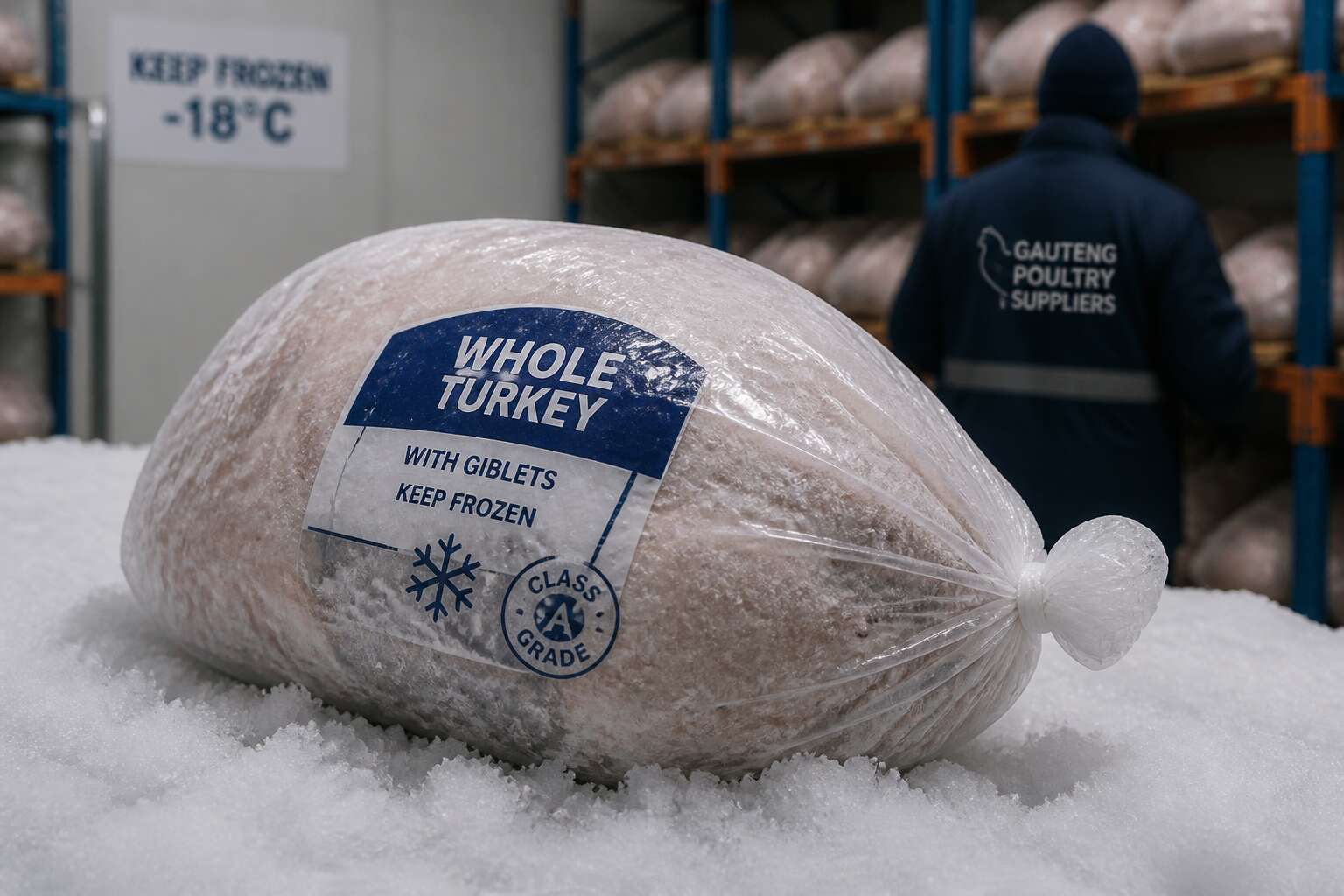
Navigating the Frozen Turkey Supply Chain in Gauteng
Why Gauteng is a Hub for Poultry Imports and Distribution
Every November, the pallets stack higher at OR Tambo airfreight depots. Frozen turkey suppliers Gauteng depend on this rhythm, where cold storage capacity and customs efficiency decide what reaches your table. Gauteng holds roughly 40% of South Africa’s cold chain infrastructure, making it the natural gateway for poultry imports moving inward from coastal ports and air hubs.
Major logistics corridors connect Durban’s harbour to Johannesburg’s distribution nodes within a single trucking day. This concentration of warehousing, bonded facilities, and freight forwarding expertise means frozen turkey suppliers Gauteng serve clients with consistent stock despite global market fluctuations. Here is what makes the local supply chain particularly resilient:
- Multiple cold storage facilities within municipal boundaries
- Direct airfreight links to Brazil and Europe
- Established customs clearance agents for perishable goods
Retailers from Soweto to Sandton draw from this central network, which stabilises regional pricing. This is why Gauteng functions as the central hub for poultry imports in the region.
Seasonal Demand Fluctuations and Their Impact on Supply
Come December, turkey orders at South African retailers climb higher than any other month. Frozen turkey suppliers gauteng move from steady restocking to urgent delivery schedules, because Seasonal demand fluctuations are predictable in timing but not in scale. One wrong forecast can leave either empty shelves or costly surplus.
Importers place orders months ahead, often guessing how many shoppers will choose turkey over lamb. When the guess falls short, stock disappears fast. When it overshoots, storage costs climb and margins shrink.
Three realities define this period:
- Lead times from Brazil or Europe stretch beyond six weeks.
- Retailers lock in volumes early, leaving limited extra stock.
- Local demand shifts with weather, public holidays, and regional traditions.
Understanding Whole Bird vs. Cut Portions in the Frozen Market
When planning a large order, one of the first decisions involves volume versus variety. It is a logistical puzzle that determines how much freezer space you will need and how versatile your menu can be. Buyers often discover that the choice between whole birds and specific cuts changes the entire dynamic of their procurement strategy. This is where the expertise of established frozen turkey suppliers gauteng truly comes into play, as they can guide you through the available stock based on current market conditions.
Opting for whole birds is often the most economical route, especially if you have the labour and preparation capacity to break them down yourself. However, this approach demands significant storage space and a skilled hand in the kitchen. Conversely, purchasing specific portions, such as breasts or drumsticks, reduces preparation time and eliminates waste, but it usually comes with a higher price tag per kilogram. The right choice hinges entirely on your specific operational needs, whether you run a high-volume catering business or a boutique deli.
The cold chain is the silent backbone of this entire industry, and navigating it successfully requires a partner who respects its fragility. A sudden break in the temperature chain can ruin an entire shipment, leading to significant financial losses. Therefore, the reliability of your chosen supplier is just as critical as the price they offer. You are not merely buying a product; you are investing in a seamless logistical operation that guarantees the quality of your goods from the warehouse to your delivery dock.
To make the most of your procurement strategy, consider these practical points:
– Lead Times: Always confirm the delivery schedule with your supplier well in advance, as stock levels fluctuate rapidly.
– Cut Specifications: Ensure the portion sizes and bone-in or boneless options match your recipe requirements perfectly.
– Packaging: Ask about packaging to prevent freezer burn, which preserves quality for longer storage periods.
Ultimately, building a strong relationship with a reliable distributor offers a significant advantage. It allows you to focus on running your business while trusting that your supplies will arrive on time and in perfect condition. A trusted partner will also alert you to potential market shifts that could affect pricing. By leveraging the local knowledge of frozen turkey suppliers gauteng, you ensure your business is never left without the essential goods it needs to satisfy your customers. This strategic approach turns a simple purchase into a competitive edge for your enterprise.
Key Regulatory and Import Policy Considerations
Every pallet of frozen turkey crossing into Gauteng carries documentation that determines its clearance. A single error in the health certificate can hold a shipment in quarantine for weeks, idling capital inside a cold container. The Veterinary Import Permit sits at the centre of this compliance process.
When evaluating a partner, I look closely at how they manage their compliance duties. The most reliable frozen turkey suppliers gauteng employ dedicated regulatory specialists who track shifting import policies.
- Verify the consignment’s country of origin appears on the approved poultry import list.
- Request the veterinary health certificate and compare species and product codes with the import permit.
Importers who partner with experienced frozen turkey suppliers gauteng grasp these details early and move goods through the chain with fewer interruptions.
Essential Qualities to Look for in a Trusted Frozen Turkey Supplier
Certification and Food Safety Compliance (HACCP, SABS)
The silence of a walk-in freezer is a sound you learn to trust; it speaks of order, control, and the quiet assurance that your supply chain won’t fracture at the worst possible moment. When sourcing frozen turkey suppliers gauteng, that assurance is built on more than just a reliable cold chain. It is built on a paper trail of compliance that separates the professional operators from the risky middlemen. A supplier is only as good as the certification stack they hold, and in this industry, that stack is non-negotiable.
The first pillar is HACCP certification. This isn’t a decorative plaque; it is a systematic approach to identifying every biological, chemical, and physical hazard that could compromise the product. A supplier who adheres to this framework demonstrates a proactive stance on safety, rather than a reactive one. Furthermore, South African operations are increasingly expected to align with the standards set by the SARS, which involves rigorous sanitary requirements. You should also look for a current and valid certificate from the local municipality, proving their facility passes routine health inspections.
Beyond the official stamps, consider the following when vetting your source:
– Cold chain integrity: Are their storage facilities sealed with temperature monitoring logs available for review?
– Traceability: Can they trace a specific bird back to the farm and the slaughter date without hesitation?
– Packaging integrity: Are the birds vacuum-sealed to prevent freezer burn, and does the packaging carry a clear production code?
Ultimately, a trusted supplier welcomes your audit of their compliance. If they hesitate to show you their HACCP plan or their latest municipal inspection report, the silence in that cold room becomes a warning, not a promise. Choose a partner whose documentation is as solid as the ice crystals on a perfectly frozen bird.
Cold Chain Integrity and Storage Capabilities
The difference between a supplier who delivers and one who fails often lives inside the cold room. You can feel it the moment you step through the insulated door. A facility that runs on habit, not protocol, carries a specific stillness. It is not the good kind of stillness.
For frozen turkey suppliers gauteng, temperature consistency is the whole game. I look for facilities that document temperature fluctuations every hour, not once a day. The cold chain should survive a power outage, a broken compressor, and a busy holiday week without a single degree of drift.
- Dedicated freezing rooms set to minus eighteen degrees or lower, with visible digital monitoring
- Pallet offloading areas that keep product inside the cold envelope during transfer
- Blast freezers that can handle large volumes quickly without raising the room temperature
Storage space matters too, but capacity alone is meaningless. A supplier with too much floor space and too little turnover holds birds longer than they should. Ask about their stock rotation schedule. Demand thermal records from the last quarter. The best frozen turkey suppliers gauteng will hand them over without a second thought.
Supplier Reputation and Industry Experience
Product Traceability and Origin Documentation
The quiet power of a trusted supplier lies in the paper trail. Every pallet of frozen turkey should arrive with a lineage, a documented path from farm to freezer. In Gauteng, where imports flow through OR Tambo and the Durban corridor, this documentation separates legitimate operations from questionable brokers.
Demand batch traceability, export health certificates, and original packing slips. The origin must be verifiable down to the specific processing plant. No exceptions!
- Vendor batch numbers matched against import permits
- Cold chain temperature logs from port to warehouse
- Country of origin and slaughter date documentation
I have watched buyers discover that a premium shipment was re-labelled stock from a less reliable source. When you compare frozen turkey suppliers gauteng, those with verifiable documentation justify their pricing. Traceability costs nothing to request, yet the absence of it can end a business in one spoiled consignment.
Packaging Standards and Delivery Reliability
Packaging tells you how a supplier treats the product before it reaches your kitchen. A torn bag or crushed carton means the cold chain was compromised somewhere along the route.
When I evaluate frozen turkey suppliers gauteng, I inspect packaging materials first. Food grade poly bags that fit snugly, reinforced outer cartons, clear labeling with production dates. These are not cosmetic details. They determine whether the bird arrives intact or arrives condemned.
Delivery reliability carries equal weight. A supplier who promises a 48 hour window must meet it without exception, every week, not just during peak season.
Here is what I check for in a delivery partner:
- Fleet temperature logs submitted with each invoice
- Pallet integrity reports from the driver at handover
- Consistent delivery windows across all seasons
That last point matters most. The supplier who delivers on a Tuesday in July will also deliver on the Tuesday before Christmas. That consistency is what separates dependable frozen turkey suppliers gauteng from the rest.
Local vs. International: Sourcing Frozen Turkeys in Gauteng’s Major Districts
Key Wholesale Hubs in Johannesburg (City Deep, OR Tambo)
Gauteng’s appetite for frozen poultry is substantial, with restaurants and caterers moving through significant volume each week. Sourcing the right product often comes down to a choice between international imports and locally produced birds. Each path offers distinct advantages, and understanding these will save your business both time and money.
International suppliers, particularly those from Brazil and the United States, dominate the import market. They provide massive scale and consistency, which is vital if you are running a high-turnover operation. However, landing costs, shipping schedules, and currency fluctuations can create unpredictability. For many buyers, the reliability of local frozen turkey suppliers Gauteng offers a more stable alternative. Local farms are often more flexible with delivery windows and can respond quicker to sudden shifts in demand.
To be fair, the decision is rarely about quality alone. It is about matching your specific operational needs to the right source.
– Assess your storage capacity; imports often require longer lead times.
– Compare price per kilogram, including all logistics fees.
– Verify the import permits versus local veterinary certificates.
– Determine if you need whole birds or specific cuts for your menu.
Ultimately, the best strategy for a business in Johannesburg or Pretoria involves building relationships with distributors who handle both streams. Whether you prioritise the cost benefits of international bulk or the agility of local producers, due diligence on your supplier’s background is non-negotiable. The market in Gauteng is competitive, but it rewards buyers who understand the supply chain. Finding dependable frozen turkey suppliers Gauteng takes effort, but the right partnership ensures your inventory remains consistent, week after week, regardless of the economic climate.
Pretoria-Based Suppliers and Retail Distribution Networks
The Role of Elandsfontein and Aeroton in Cold Storage Facilities
The sheer scale of cold storage requirements in Gauteng demands more than mere warehouse space, it demands strategic positioning. Elandsfontein and Aeroton serve as the twin citadels of this temperature controlled realm, safeguarding product integrity along the N3 and M1 corridors. Within these fortified walls, the distinction between local and international sourcing becomes a tactical exercise rather than a simple choice.
Local suppliers understand the rhythms of the South African table, from the December braai to the Easter Sunday feast. International imports offer volume and consistency, yet traversing the logistical gauntlet from Cape Town Harbour or OR Tambo International requires a partner with intimate knowledge of these cold chain fortresses. The mechanics of procurement hinge upon storage capacity and turnaround speed:
1. Rapid defrosting schedules align stock rotation with immediate demand.
2. Backup freezer systems protect against load shedding interruptions.
3. Strategic cell placements within Elandsfontein reduce retrieval times.
Aeroton’s facilities excel in handling break bulk operations for independent butchers, while Elandsfontein focuses on full pallet movements for larger distributors. This division of labour clarifies which frozen turkey suppliers gauteng buyers should approach based on their specific volume requirements. The chosen facility determines the pace of the supply dance, and the stakes are nothing less than the quality of the final product on a thousand dinner tables.
Evaluating Local Farm Offerings vs. Imported Brands (Brazil, US, Europe)
When a Gauteng host promises a Christmas turkey, the unspoken question is whether that bird flew in from a Mpumalanga farm or a Brazilian processing plant. The answer shapes the dinner table, and the budget. Local offerings often carry a heritage appeal, with breeds like the Bronze or White Holland raised closer to home. These birds may have a shorter supply chain, but they also demand precise timing. You cannot simply phone a local farmer in June and expect a December delivery. Their production cycles are planned around confirmed orders, leaving little room for spontaneous expansion.
Imported brands from Brazil, the United States, and Europe operate on a different rhythm entirely. They offer a consistent, year-round volume that local farms cannot always match. The Brazilians, in particular, have mastered the art of producing a uniform bird at a scale that makes price competition almost unfair. For many frozen turkey suppliers gauteng, this reliability is a comfort. A buyer for a large catering company knows that a pallet of Brazilian turkeys will arrive on the scheduled date, with predictable sizing and a homogeneous appearance. The trade-off is a certain sameness. There is rarely a surprise in a Brazilian turkey, but neither is there a risk.
The decision often boils down to the specific district and its customer base. A butcher in Sandton might advertise a free-range local turkey as a premium item, while a wholesaler servicing the weekend taxi rank trade in Soweto needs the unbeatable price point of a European or South American import. The local product has a story, but the imported product has a spreadsheet. When assessing which direction to take, buyers consider the crucial factors of cost, yield, and delivery windows:
1. The cost per kilogram, which often favours the imports.
2. The lead time for securing local birds, which is significantly longer.
3. The flexibility of importers to hold stock in cold storage, delaying the final sale.
4. The provenance documentation, which is more complex for international shipments.
The labelling on a frozen turkey tells its own quiet story of origin. South African regulations demand precise indication of the country of origin, a fact that savvy shoppers now scrutinize. This scrutiny benefits the local producer who can justify a higher price with a shorter travel history. Yet, the volume issue remains intractable. The high season demand in Gauteng can outstrip the local supply capacity by a factor of three. That shortfall is filled by the constant arrival of container ships at Durban and cargo planes at OR Tambo. A buyer looking for a specific weight range, say a 6 to 8 kilogram bird, might find that the local option offers only the higher end of that scale. The importers are there to fill the rest.
Cost Optimization, Logistics, and Bulk Purchase Strategies
Pricing Structures and Volume Discounts for Bulk Orders
In Gauteng’s frozen poultry trade, the margin between profit and loss often hinges on the arithmetic of scale. Bulk purchasing remains the surest lever for cost optimization, yet it demands a precise understanding of storage overheads and delivery scheduling. Buyers who consolidate their orders to match cold chain capacity typically secure better per-kilogram rates while avoiding the silent drain of repeated small-batch transport fees. The logic is simple: every trip into the city’s distribution corridors carries a fixed logistical cost, and spreading that expense across a larger volume diminishes its sting.
When negotiating with frozen turkey suppliers in Gauteng, volume discounts rarely follow a flat curve. Instead, they cascade in deliberate tiers that reward commitment. A buyer moving beyond the baseline pallet quantity unlocks a secondary price bracket, while those who commit to scheduled monthly off-takes often negotiate rebates on the freight itself. This layered structure encourages a rhythm of predictable demand, which suppliers reward with preferential scheduling.
– Orders exceeding 500kg typically unlock a 5% to 8% price reduction.
– A commitment to 1,000kg monthly volumes often includes delivery cost absorption.
– Off-season advance contracts, placed between demand spikes, can yield an additional 10% concession.
Logistics remains the quiet variable in this equation. The distance from the port of entry to a Gauteng cold store, coupled with the cost of maintaining the requisite negative temperatures, is frequently folded into the quoted unit price. Savvy procurement teams therefore evaluate the landed cost, not just the sticker price. They factor in the number of break-bulk points and the reliability of the delivery fleet, because a missed slot in a chilled supply chain carries a hefty price in spoilage risk. Ultimately, the most effective negotiations pair a firm volume promise with a flexible delivery window. That combination allows the supplier to optimise their own trucking routes, and the savings are often shared with the buyer. This synergy between committed quantity and logistical agility defines the true value proposition for any serious purchaser in the region.
Calculating Delivery and Freight Costs within the Gauteng Region
The cost of moving a pallet from Durban harbour to a Johannesburg cold store can swing by more than 15% depending on departure time and return freight. Most buyers who source from frozen turkey suppliers gauteng never ask what the truck does after it drops their order.
Backhauling is the hidden lever. When a transporter picks up a return load from a Gauteng warehouse instead of travelling back to the coast empty, the saving can flow to the buyer who requests it. Delivery windows that fit a supplier’s existing route through City Deep or Aeroton reduce the per-pallet freight line. Calculating delivery and freight costs within the Gauteng region requires reviewing more than the quoted transport fee.
- Fuel and tolls on the N3 and N1 corridors, which adjust quarterly.
- Demurrage at break-bulk points when a truck waits beyond its booked slot.
- The price difference between daytime and off-peak delivery slots.
Factor these into the landed cost and it becomes clear why two frozen turkey suppliers gauteng quote differently for identical products. The gap is rarely the bird itself. It is the road, the waiting time, and the empty return leg.
Managing Buffer Stock and Cold Storage Rental Options
One unsung cost in the poultry trade is the cold storage rental itself. Most buyers overlook that the tariff for a pallet position in Aeroton changes with the ambient season. When the Highveld heats up, demand for freezer space spikes and so does the per-pallet rate. Frozen turkey suppliers gauteng often hold stock at leased facilities, and those holding costs quietly inflate the final price per kilogram.
A reliable buffer stock protects you from supplier stockouts and transport delays, but it ties up capital. Consider the split between a short-term overflow solution and a long-term contract. The options usually differ in these ways:
– Monthly rental on a per-pallet basis with no commitment
– A seasonal lease that covers only the summer peak
– Shared cold storage space, which offers lower rates but less control
– Dedicated rooms with a premium rate for exclusive access
The trick is negotiating a rate that flexes with your incoming container schedule. If you coordinate your bulk order with an off-peak storage period, you can reduce overheads without compromising supply. Engaging frozen turkey suppliers gauteng who use a third-party warehouse with flexible terms is often better than owning or tying yourself to a rigid facility. The buffer exists to serve your sales curve, not the other way around.
Negotiating Season-End Deals and Off-Peak Purchase Advantage
The rhythm of the poultry trade in Gauteng is rarely linear. When the December feasts and Easter long weekends fade, a quieter window opens. Historically, bulk buyers who wait for this lull, often between February and May, pay significantly less per kilogram than those chasing peak demand. This is the period when logistic chains loosen and frozen turkey suppliers gauteng adjust their holding patterns.
Timing your procurement around this seasonal sag is a strategic move. Here is what a smart negotiation usually hinges on:
1. A commitment to take a specific volume off their hands before the next major container lands.
2. Engaging with a freight forwarder to align your purchase with their return-load schedules, cutting delivery costs in the process.
3. A willingness to accept shorter shelf-life labels, which many retailers refuse, giving you leverage on the unit price.
The off-peak advantage extends beyond the invoice. During these months, cold storage facilities in Aeroton and Elandsfontein have spare capacity. The per-pallet rates drop, and the pressure to rotate stock diminishes. When you lock in pricing during this surplus, you are not just buying the bird; you are buying the logistics of a slower season. Freeing up capital flow is a tangible benefit, as the difference in outlay often funds the freight for the next load. This is the quiet leverage that separates a savvy operator from a reactive buyer.
Flexible Payment Terms and Credit Facilities for Regular Buyers
Some buyers only look at the price per kilogram. They miss the deeper value a supplier can unlock through financial flexibility. For a business in Gauteng that orders regularly, the conversation should shift away from simple unit costs. A dependable supplier of frozen turkey suppliers gauteng can offer credit facilities that smooth out cash flow for their regular clients.
A 30 day account, for instance, allows a caterer to stock up for a major event and pay after the invoices are settled. This arrangement provides working capital headroom for other operational demands.
When negotiating your bulk purchase strategy, consider asking about these terms. The benefits often include:
– Extended payment terms.
– Seasonally adjusted pricing for loyal customers.
– Priority allocation on high demand periods.
– Reduced delivery fees for high volume accounts.
Formalizing a credit agreement with frozen turkey suppliers gauteng creates a partnership. It means your supplier understands your business cycle. This can translate into better service, from holding reserved stock to notifying you of market shifts before they hit the public. This kind of relationship is the true value in bulk purchasing.
Common Pitfalls and Pro-Tips for Caterers and Retailers
Avoiding Thawing and Re-freezing Quality Issues
The quiet hum of a walk-in freezer can be the loudest alarm in a professional kitchen. A temperature fluctuation of even a few degrees here in Gauteng’s variable climate often initiates a cycle that ends in a pale, waterlogged bird. The true danger in the frozen meat supply chain is not the initial freezing, but the slow, repetitive thawing and refreezing that destroys cellular integrity. When a supplier’s cold storage facility in Kempton Park or Germiston experiences a power dip, the damage begins long before the product reaches your receiver. It is a quality issue that no marinade can mask.
Caterers often misjudge the defrosting timeline, pulling stock from the freezer without a plan. They might thaw a 5kg bird overnight at room temperature, which is a direct invitation for bacterial proliferation on the outer layers while the core remains solid. Re-freezing such a bird is a catastrophic error for both texture and safety. The ice crystals that form during a second freeze are larger and sharper, lacerating the muscle fibres. This leads to a dry, stringy roast that loses volume when cooked. For the retailer, the issue is often aesthetic; a product that shows freezer burn or a cloudy exudate on the packaging simply will not sell. You must treat the thawing schedule with the same precision as the cooking schedule.
– Inspect packaging for frost or ice crystals inside the plastic, which indicates prior thawing.
– Never let the bird sit in standing water during the thaw process; use a cold water bath with a circulating fan.
– Track the internal temperature during thawing; it should never rise above 4 degrees Celsius for core safety.
– Always transfer stock using the First In, First Out method to prevent older batches from being cycled through multiple temperature changes.
Partnering with reliable frozen turkey suppliers gauteng is the first line of defence. However, the responsibility shifts to you the moment the truck doors open. A reputable supplier maintains a stable cold chain, but your own handling protocols dictate the final result. If you negotiate a volume discount in a bulk order, ensure your own cold storage capacity is sufficient to accept the entire load without overloading the evaporator coils. Overstacking a freezer blocks airflow, creating warm pockets that initiate premature thawing at the pallet’s core. The difference between a succulent holiday special and a rubbery disappointment lies in the discipline of your own cold room management. Look for a frozen turkey supplier in Gauteng that offers clear handling guidelines on their delivery slips to bridge the gap between their warehouse and your preparation line.
Understanding Halal and Non-Halal Certification Requirements
According to the South African National Halal Authority, over 80% of local caterers have served a non Halal bird to a Halal client at least once. That statistic is terrifying, especially when you consider that most frozen turkey suppliers gauteng offer both Halal and non Halal lines. The pitfall is assuming certification is static. A supplier’s Halal status can lapse, or their certificate might only cover a specific processing plant.
Pro tip: always request a copy of the current certificate, not a PDF from last year. Check the endorsement date and the issuing body. Also, look for the SANHA logo on the packaging itself, not just on the delivery invoice.
- Confirm whether the cold storage facility is Halal compliant separately from the slaughterhouse.
- Ask if the turkey is hand slaughtered or machine slaughtered, as some authorities only accept hand.
Leveraging Digital Platforms to Compare Supplier Quotations
Price discrepancies often hide in plain sight. A quotation for frozen turkey suppliers in Gauteng might look competitive at first glance, yet the devil lurks in delivery fees, cold chain surcharges, and minimum order clauses. When you compare quotations side by side, you need to look beyond the per-kilogram rate. Ask for a full breakdown that includes storage costs if you need to delay collection, and confirm whether the price holds during peak demand weeks. Some suppliers quote a festive season premium that only appears once you commit to a volume.
Digital platforms make this comparison easier, but they also create a false sense of security. You might think you are comparing apples with apples when two suppliers quote for a whole frozen bird, but one includes giblets and the other does not. Check the specifications carefully. A lower price per kilogram might mean a smaller average bird weight, which could throw off your catering yields. It pays to request the exact weight range and grade for every quotation you receive.
Verification does not stop with the supplier. You should always cross-check the certificate numbers against the South African National Halal Authority database. A digital platform might display a logo, but that logo could belong to the parent company while the actual depot operates under a different licence. When you shortlist potential vendors, call them directly and ask which facility will dispatch your order. That single question often reveals whether the cold storage and the slaughterhouse operate under the same compliance umbrella. In Gauteng, where logistics hubs like City Deep and OR Tambo handle massive volumes, the origin of your shipment can change the paperwork trail entirely.
Here are a few quick checks that save you from costly mistakes:
– Request the quotation in writing with a validity period of at least 14 days.
– Confirm whether the price includes VAT and any delivery zone surcharges.
– Ask for the batch number and the corresponding health certificate for each load.
– Verify the supplier’s capacity to hold your order if your kitchen faces an unexpected delay.
The most seasoned buyers in Johannesburg know that a digital comparison is only the starting point. They build relationships with two or three suppliers who consistently answer the phone, not just the ones with the flashiest websites. A supplier who offers a slightly higher quote but has a reliable cold chain and transparent documentation often saves you money in the long run, because you avoid rejected loads and last-minute substitutions. When you are handling frozen poultry, the margin for error is thin. One warm cycle during transport can render an entire batch unsellable, and no digital platform will cover that loss.
Building Long-Term Partnerships with Local Distributors
A supplier relationship that survives the December rush is built on more than a signed contract. The caterers who thrive in this market are the ones who learned their lessons during quieter months, when mistakes cost less and tempers stay cooler. One restaurateur in Midrand shared a story about a pallet that arrived with torn packaging and frost-damaged birds, a total loss that no digital comparison could have predicted.
The most common pitfalls surface when buyers treat every order as a standalone transaction. They chase the lowest quote each week, losing the leverage that comes with consistent volume. They also overlook the subtle differences in how distributors manage their cold chain. A depot in Aeroton might offer competitive rates, but if their dispatch schedule clashes with your kitchen’s receiving hours, those savings evaporate quickly.
Pro-tips for building durable partnerships with frozen turkey suppliers gauteng:
– Visit the distributor’s facility unannounced. Check the thermometers yourself and observe how staff handle product rotation.
– Establish a single point of contact who knows your order history and can flag potential shortages before they become crises.
– Negotiate a service level agreement that covers response times for quality complaints and replacement protocols.
– Pay attention to how the supplier handles their own stock levels. A distributor who overcommits to retail chains will leave you stranded.
The buyers who get the best service treat their suppliers as extension of their own operations. They share their event calendars and projected volumes, which allows the distributor to plan their imports accordingly. This transparency creates a buffer during peak weeks, when demand from smaller clients often gets pushed aside. When you consistently communicate your needs, you become a priority customer, not an afterthought.
The quiet truth about this industry is that nobody advertises their failures. A distributor who lost a load of Brazilian whole birds to a power outage will not volunteer that information. You have to ask direct questions about their backup generators and their protocols for temperature excursions. The answers reveal whether they operate with genuine redundancy or mere compliance. For those who take the time to dig, the rewards come in the form of dependable supply. For everyone else, there is always the premium market, where frozen turkey suppliers gauteng charge extra for the privilege of reliability. That premium is often worth every rand when the alternative is an empty display case during the holidays. Most caterers eventually learn that the real product being sold is trust, not poultry. The birds are merely the physical proof of that partnership.


0 Comments