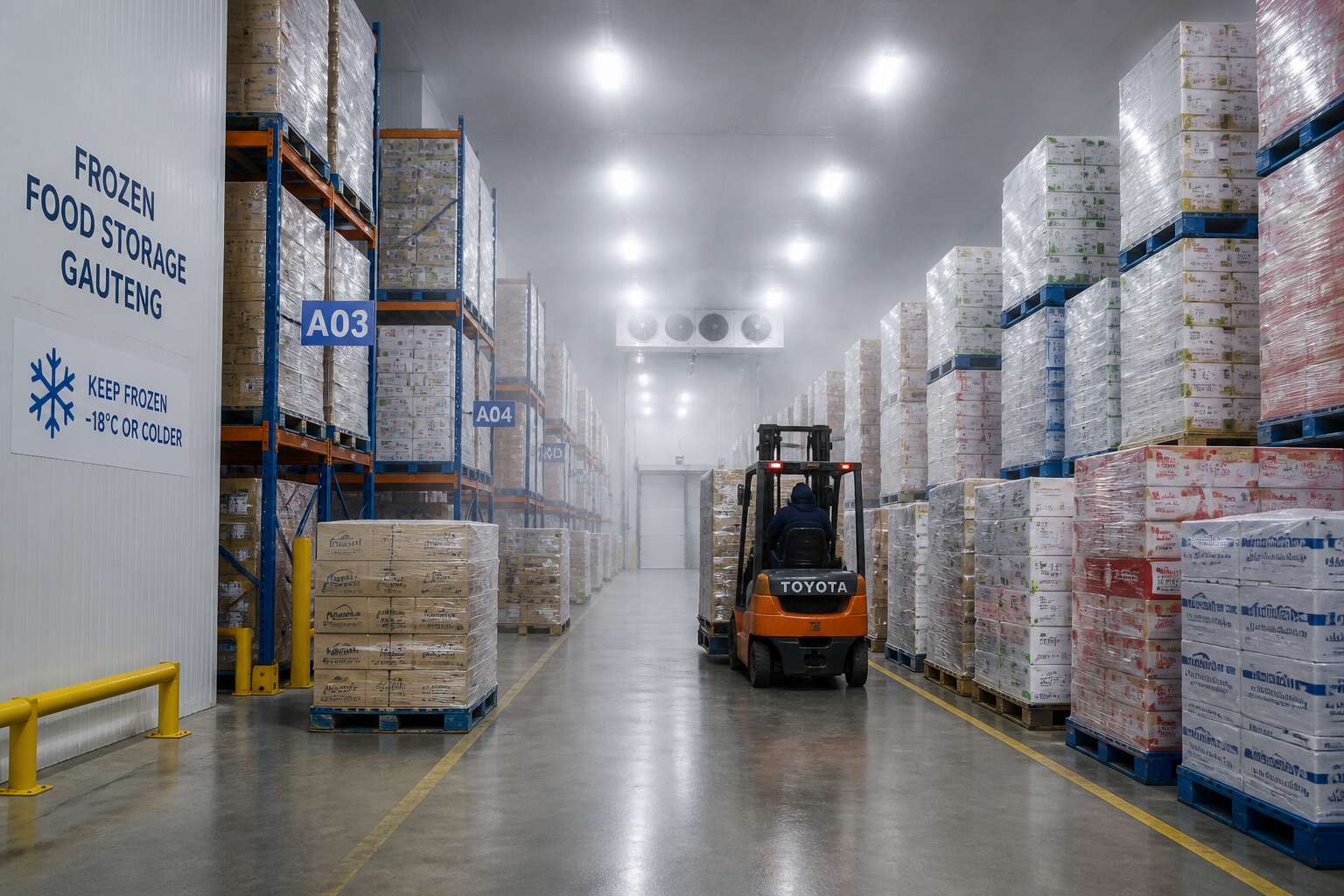
Understanding the Gauteng Cold Chain Landscape
The Importance of Temperature-Controlled Logistics in Gauteng
Gauteng moves more frozen goods than any other South African province, and that volume demands precision. Temperature-controlled logistics are the foundation of food safety here. When a shipment leaves a warehouse in Johannesburg or Ekurhuleni, every minute matters!
The landscape is shaped by dense urban corridors and sprawling industrial nodes. Cold storage frozen food distributors gauteng rely on a patchwork of routes, each with its own challenges. Load shedding, traffic congestion, and fluctuating diesel prices all test the integrity of a cold chain. A single degree of variance can compromise an entire pallet. For distributors, the priorities are clear:
- Maintaining consistent temperatures from dock to delivery
- Monitoring cold chain data in real time
- Coordinating with retailers who demand strict compliance
Cold storage frozen food distributors gauteng must also navigate the province’s highveld altitude, which affects refrigeration efficiency. Seasonal storms can delay transport. Understanding this landscape means respecting its complexity. Temperature-controlled logistics in Gauteng require constant vigilance, from the hum of the compressor to the final handshake at a supermarket receiving bay.
Key Hubs for Frozen Goods: Johannesburg, Pretoria, and Ekurhuleni
Understanding the Gauteng Cold Chain Landscape Key Hubs for Frozen Goods: Johannesburg, Pretoria, and Ekurhuleni
Gauteng’s frozen food network operates across three distinct regions. Johannesburg handles the highest turnover of chilled exports, with warehouses clustered near the M2 corridor and City Deep. Pretoria’s distributors serve a steadier, more institutional clientele: schools, hospitals, and government suppliers who expect consistency. Ekurhuleni, home to OR Tambo, offers the only direct airfreight option for urgent frozen consignments.
Each hub demands a different pace from cold storage frozen food distributors gauteng:
– Johannesburg demands overnight dispatch coordination and constant dock activity.
– Pretoria favours scheduled delivery windows and predictable lead times.
– Ekurhuleni prioritises customs clearance and rapid transfer between air and road.
The social nuance matters here. Retail buyers in each hub remember a supplier who misses a delivery slot, and they also remember one who arrives prepared with proper documentation and intact pallets. Success in Gauteng’s frozen food sector often depends on local knowledge as much as refrigeration capability.
The Difference Between Cold Storage Warehousing and Distribution
Space and movement. They sound like the same thing when you are freezing, but in Gauteng, they are entirely different businesses. A cold storage facility is a silent, frozen cathedral of pallets. A distribution operation is a chaotic symphony of reversing trucks and shouting dispatch clerks. The difference is everything.
One of my clients once stored 10 tons of boerewors in a facility for two weeks. The storage bill was a fraction of what he paid me for a single weekend of urgent deliveries to four different Woolworths DCs. That is when the penny dropped. Cold storage frozen food distributors gauteng do not just hold your product in the dark. They negotiate the perilous journey from the freezer door to the retail shelf.
The confusion between the two services is common. It is also expensive.
Here is the breakdown of what you are actually paying for:
– Storage: You pay for space, whether you use it or not. It is a fixed cost. Think of it as paying rent on a fridge you are not living in.
– Handling: This covers the physical labour. Moving your stock from the dock to the rack, then back again. If you are moving to a new facility, this is where the costs spike.
– Distribution: This is the true test of mettle. It involves transport, route planning, fuel, drivers, and the unglamorous reality of traffic on the N1.
– Fleet Composure: This is the unofficial cost. It is the price of a driver who understands that a cross-dock in Kempton Park is not a scenic viewpoint.
Mix in idle promises and you are effectively paying a premium to store a problem. Cold storage frozen food distributors gauteng often provide both functions, but you must force them to separate the line items.
The real insight is that a warehouse manager is measured on rack occupancy. They are paid to keep the building full. A distribution manager is judged on dispatch times and delivery integrity. These are opposite goals. One wants to hold your stock still, the other needs to move it to survive.
A facility with a high “dwell time” is a warehouse. A facility where the pallets barely have time to frost over before they are loaded again, that is a distribution centre. The most dangerous question you can ask a storage provider is: “Can you have this in Rustenburg by 10am tomorrow?” If they hesitate, they are just a landlord with a big fridge and a rented truck. You need a distributor who thrives on the chaos of the open road.
How the Local Supply Chain Impacts Perishable Goods
Gauteng moves roughly sixty percent of South Africa’s frozen imports through its depots and cross-docks. That statistic hides a human reality. Every pallet of chicken livers is a promise made to a shopper in Soweto or a butcher in Centurion. The landscape dictates the terms: the altitude, the distance from Randburg to the ports, the gridlocked arterials.
I have watched dispatch managers pace the floor for hours waiting on a truck that should have docked at dawn. Perishable goods wait for no one. This is why cold storage frozen food distributors gauteng operate on narrow windows where a single delayed truck ripples backward through the entire chain.
- The N3 corridor funnels coastal cargo toward Gauteng, creating dawn bottlenecks.
- Load shedding disrupts cold chain monitoring systems, forcing manual checks.
- Retail DCs enforce strict delivery windows, punishing early or late arrivals.
Understanding the landscape means accepting that your product is only as safe as the network carrying it.
Core Capabilities of Top-Tier Frozen Food Distributors
Advanced Freezer Storage Facilities and Temperature Ranges
Inside any serious freezer facility, temperature is precisely controlled and continuously verified. Deep freeze bays hold steady at -25°C. Blast freezers push down to -40°C, pulling heat from product rapidly to prevent large ice crystals from forming. Every doorway, every pallet shift, every sensor reading matters.
Cold storage frozen food distributors gauteng build redundancy into their cooling systems so a compressor failure never becomes a product loss. The physical plant tells you a lot:
- Multi tier racking for dense SKU storage without compromising airflow
- Refrigerant gas detection that alerts long before anyone smells a problem
- Continuous data logging tracking fluctuations to tenths of a degree
Freezer storage of this calibre protects your stock, your margins, and your reputation.
Blast Freezing and Rapid-Chill Solutions for Quality Retention
A product’s fate is sealed within the first hour after slaughter or harvest. The difference between a superior frozen product and a mediocre one is often a matter of minutes. Cold storage frozen food distributors gauteng rely on blast freezing to bridge that gap. This process pushes temperatures to minus forty degrees Celsius, forcing heat out of the product at a speed that preserves cellular integrity. The physics are simple. Smaller ice crystals form, which means the texture and moisture content remain intact when the consumer finally defrosts the item.
Rapid-chill solutions are not limited to raw proteins. Prepared meals, sauces, and bakery items all respond better to a swift temperature drop. The equipment in a modern facility can handle these varying loads without cross-contamination. Gauteng distributors often deploy dedicated lines for different product types, ensuring that a batch of cooked food never shares a cooling chamber with raw meat. The operational benefits are measurable. A facility with these capabilities offers clients a distinct advantage. Consider the value of a freezer chain that never forces a product to wait in a queue.
– Reduced shrink from dehydration and weight loss.
– Better colour and flavour retention in the final product.
– Extended shelf life because bacterial growth halts quickly.
– Fewer rejected loads at the retailer’s receiving bay.
The true cost of a logistics partner is not the invoice. It is the quality of the food that arrives at the end of the line. Those who understand this nuance will find that the best cold storage frozen food distributors gauteng offers are those who treat the cold chain as a craft, not just a utility.
Inventory Management Systems for High-Turnover Frozen Stock
A pallet that cannot be found might as well be lost. The best cold storage frozen food distributors gauteng track every carton with precision. Inventory systems measure stock down to the minute.
High-turnover environments punish guesswork. Products enter, rotate, and leave within tight windows. Top-tier distributors monitor batch codes, expiry dates, and storage duration. This visibility prevents stock from sitting past its prime.
Consider what a good system tracks:
– Pallet-level traceability against incoming loads.
– Automated alerts for stock nearing its limit.
– Real-time integration with client ordering systems.
Without these layers, a distributor remains blind to what sits inside the freezer. Data management affects the human side. When a system runs correctly, the staff trust it. They move faster and make fewer mistakes. The operation feels calm because decisions rest on what is in the building. That reliability separates true cold storage frozen food distributors gauteng from landlords who own freezers.
Specialised Handling for Meat, Seafood, and Ready-Made Meals
Specialised handling separates premium operators from ordinary warehouses. Meat requires stable temperatures to prevent moisture loss and bacterial growth. Seafood demands faster, gentler freezing cycles to preserve texture and flavour. Ready-made meals need strict segregation from raw proteins, often within the same facility.
Cold storage frozen food distributors gauteng must adapt their workflows to each product’s biological behaviour. That means dedicated equipment and trained staff who understand thawing curves, drip loss, and odour transfer risks. Here is what separates top-tier performance:
- Segregated storage chambers with independent temperature controls.
- Product-specific probes that monitor core temperatures, not just air.
- Colour-coded pallets and racks to prevent cross-contact.
These capabilities reduce spoilage and safeguard food safety compliance. A distributor that applies the same handling method to all frozen goods will lose clients quickly. The best ones invest in nuanced infrastructure because frozen food does not forgive shortcuts.
Navigating Distribution Networks and Transportation
Last-Mile Delivery to Retailers and Food Service Providers
A ten minute delay at a Johannesburg intersection can shift the temperature inside a freezer trailer by two degrees. For cold storage frozen food distributors gauteng, that shift decides whether a delivery arrives compliant or compromised. Last-mile delivery is the final test of the entire cold chain.
The journey from Ekurhuleni to a Pretoria restaurant introduces variables no office can predict. Traffic, dock access, and the pace of a storekeeper’s signature all influence the product. Distributors sequence stops by distance and thermal tolerance, and drivers reroute around roadworks using real time data. Some vehicles run dual temperature zones, allowing frozen and chilled goods to share a trip safely. Every rand depends on this precision.
Cold Chain Traceability and Real-Time Monitoring
Every route across Gauteng is a calculation. For cold storage frozen food distributors gauteng, the network is not a straight line between warehouses and doors. It links weighbridges, loading docks, and temperature thresholds. Real-time monitoring tracks each vehicle through every stage. Telematics feed data on door openings, compressor cycles, and thermal drift.
Traceability extends beyond the trailer. Each pallet carries a digital fingerprint. When a shipment pauses at a checkpoint, the system records idle time and ambient temperature. This data flows to a central dashboard, where dispatchers compare live conditions against the product’s tolerance profile.
- Route optimisation software pulling traffic patterns from metro sensors
- Cold chain traceability logs timestamping every stop and seal break
These tools do not replace human judgment. They sharpen it. For cold storage frozen food distributors gauteng, a driver who sees a spike can isolate the pallet before it contaminates the load.
Route Planning for Gauteng’s Highly Trafficked Corridors
Gauteng’s highway network demands precision. The N1’s eastern bypass synchronises with the working day: empty at 3am, a parking lot by 7am. For cold storage frozen food distributors gauteng, those windows decide the schedule.
Dispatch teams study the corridors with care. The N3’s heavy vehicles pass through Leondale at their own pace. The N12’s lane closures appear without warning. Summer storms flood the R21’s low sections near Centurion, just as the morning rush builds.
The variables multiply by season:
– Weighbridge waiting at Vereeniging that creates long delays
– Truck ban enforcement that tightens ahead of holidays
– Fuel shortages creating queues around depots in Boksburg
Cold storage frozen food distributors gauteng account for every factor. A route chosen at 4am is often useless by noon. The roads keep moving, and the trucks must move with them.
Temperature-Controlled Cross-Docking and Transhipment
Every transhipment point in Gauteng is a relay station. A pallet of frozen vegetables arrives at a Spartan cross-dock, waits forty minutes in a forced-air unit, and leaves on another truck headed for Pretoria. Transferring frozen product between vehicles without letting the temperature climb above negative eighteen degrees is the whole game.
For cold storage frozen food distributors gauteng, the network runs on timing. A cross-dock is a passage, not a warehouse. The best sites operate with a dock-to-dock window under an hour. Transhipment in Midrand or Germiston cuts delivery times. The discipline shows in small details:
– Inbound and outbound doors matched before the truck arrives
– Temperature alarms checked on every pallet during the swap
– Paperwork cleared while product sits inside the trailer
A bay door left open ten minutes raises the temperature. That ruins the batch. Done right, the network absorbs the chaos of Gauteng’s traffic and delivers anyway.
Evaluating Fleet Capacity and Refrigeration Technology
Every minute a trailer door opens in Berea, the cargo loses measurable shelf life. Fleet capacity is not about having enough trucks, it is about matching refrigeration technology to the specific load. That is why cold storage frozen food distributors gauteng obsess over trailer configuration as much as route optimisation.
Modern multi-temperature units allow one vehicle to carry frozen ready-meals for Midrand restaurants alongside bulk seafood for OR Tambo cargo handlers. Telematics track door cycles and evaporator coil performance in real time. A driver waiting at a Kya Sands checkpoint triggers an alert before the temperature climbs.
- Standby electric units protect cargo during scheduled maintenance
- Thermal mapping identifies hot spots inside each trailer before loading
These decisions turn a simple delivery run into a precise operation. For cold storage frozen food distributors gauteng, the margin for error is measured in minutes.
Compliance, Safety, and Industry Regulations
Adhering to South African Health and Agricultural Standards
A single degree of temperature drift can invalidate an entire consignment. Cold storage frozen food distributors gauteng understand this viscerally, but regulatory adherence extends well beyond the thermometer. South Africa’s legislative net weaves together multiple instruments. The Meat Safety Act, the Foodstuffs, Cosmetics and Disinfectants Act, and the Agricultural Product Standards Act each impose duties that operators cannot sidestep.
The Department of Agriculture, Land Reform and Rural Development conducts unannounced audits. The National Regulator for Compulsory Specifications polices calibration equipment and storage accuracy. Municipal health inspectors hold broad cessation authority, and they do exercise it without hesitation.
Core compliance touchpoints include:
- Verified hazard control documentation for every product line
- Thermal calibration records traceable to the South African Bureau of Standards
- Transport inspection logs covering cross-contamination risks
Cold storage frozen food distributors gauteng must treat these rules as a partner, not a burden. The paperwork feels unglamorous. It also stands between a distributor and a costly product write-off.
The Role of Consumer Protection and Food Safety Measures
Unsafe food costs low and middle income economies more than one hundred billion dollars every year. When a consumer opens a packet of frozen chicken, they trust a logistics network they will never see. That trust rests on cold storage frozen food distributors gauteng. The obligation is moral before it is legal.
Consumer protection in this industry depends on verification, not labels. A product’s journey must leave a verifiable record. This matters most where failure causes the deepest harm:
- Traceability systems linking each batch to its origin
- Microbiological testing schedules for high risk protein lines
- Recall protocols that isolate a single pallet within minutes
Food safety measures carry public trust without spectacle. They earn no headlines until they fail, and failure is swift. For cold storage frozen food distributors gauteng, compliance is the least visible product they move, and it is the only one that truly matters.
Environmental Sustainability in Cold Storage Operations
Environmental compliance often goes unnoticed, yet it shapes every choice cold storage frozen food distributors gauteng make. Refrigeration gases are the obvious concern. The Kigali Amendment is phasing down hydrofluorocarbons, and South African industry regulations require leak detection records, service logs, and proof of gas recovery.
Energy complicates things. A freezer room draws enormous power! Load shedding forces facilities to switch between grid, diesel, and battery storage. Each transition affects temperature stability and emissions. Good operators automate defrost cycles to match electricity tariffs and use solar arrays to reduce reliance on backup.
Every reliable distributor keeps three documents on file:
- Refrigerant leak test results
- Generator maintenance schedules
- Waste disposal certificates for old oils and coils
For cold storage frozen food distributors gauteng, these documents reveal a safety culture. Without them, a distributor is guessing.
Contingency Planning for Power Interruptions and Load Shedding
When the lights die in Gauteng, the silence in a freezer warehouse is deceptive. The hum of compressors stops. The cold remains, but only for a time. Cold storage frozen food distributors gauteng operate under a different clock during load shedding, one measured in degrees per minute.
Contingency plans are not theoretical documents. They are tested rituals. Backup generators must start within seconds. Battery banks must bridge the gap. Each transition, from grid to diesel to solar, introduces a risk of temperature fluctuation that inspectors will question. The best cold storage frozen food distributors gauteng maintain a disciplined protocol:
– Generator start-up logs with weekly test dates
– Battery health assessments and replacement schedules
– Temperature recovery times recorded after each power event
Compliance demands more than intention. South African regulations require documented proof of readiness. Facilities that neglect these protocols face penalties, but worse, they lose the confidence of their clients.
Choosing the Right Frozen Food Distributor in Gauteng
Evaluating Storage Capacity and Scalability Options
Storage capacity is the often ignored factor when choosing cold storage frozen food distributors gauteng. I have watched retailers lock in contracts with impressive pricing, only to discover the warehouse cannot handle peak season surges. A distributor’s scalability determines whether your growth stalls or accelerates.
Consider the fundamentals when evaluating capacity:
- Pallet positions available at your required temperature range
- Expansion plans for additional freezer space
- Backup refrigeration during load shedding
Gauteng’s frozen food market moves quickly. A facility operating at 90% capacity leaves little room for emergency stock or new product lines. You need a partner whose infrastructure matches your forecast, not merely your current volume. Understanding their maximum throughput during winter peaks reveals whether they can absorb your business as it expands.
Analysing Distribution Reach and Client Support Services
Ask any cold storage manager in Gauteng: the fastest route on the map is not a promise of delivery. When evaluating cold storage frozen food distributors gauteng, distribution reach is more than suburb-to-suburb coverage. It involves understanding which routes your goods will travel, how often, and during which hours. A distributor that services Krugersdorp but not Midrand might still be ideal if your retail footprint sits on the West Rand.
Client support matters as much as geolocation. You want a partner who answers a cold chain alert at 03:00 without a grumble. Before signing, test their response time. Ask for a mock recall or a last-minute delivery change. Observe how their team handles pressure.
Consider these support elements:
- After-hours contact for refrigeration breakdowns
- Dedicated account manager for frozen stock queries
- Transparent reporting on delivery confirmations
Solid cold storage frozen food distributors gauteng offer these without hesitation. If you get excuses, that reveals more than any marketing brochure.
Comparing Value-Added Services: Labelling, Repackaging, and Pallet Jacketing
Value-added services reveal the real capability of cold storage frozen food distributors gauteng. Labelling might seem simple, but incorrect barcode placement or batch numbers can halt a retail delivery. In-house labelling removes that risk before stock leaves the facility.
Repackaging is equally practical. Bulk frozen chicken portions might need splitting into consumer packs. Ready-made meals often require portion-controlled packaging for catering clients. A distributor that handles this internally saves time and maintains the cold chain.
Pallet jacketing gets overlooked. Proper shrouding guards cartons against moisture and temperature shifts during transit. Distributors offering these services:
- Reduce handling damage
- Maintain packaging integrity
- Speed up turnaround times
Fee structures vary across cold storage frozen food distributors gauteng. Some bundle these services into storage rates. Others itemise them separately, which changes the cost comparison.
Assessing Technology Integration and Cold Chain Visibility
Visibility is power in the frozen food sector. The best cold storage frozen food distributors gauteng offer more than a shared track-and-trace link. They provide a window into the product’s entire journey, from the moment the pallet enters the facility to the second it docks at your customer’s loading bay. This transparency directly protects your brand reputation. One integration for your ERP system can turn a mountain of data into a simple view of your inventory levels.
When evaluating a partner, ask what systems they run and what you can actually access. A distributor leveraging real-time telemetry on its fleet reduces the risk of silent temperature excursions. That data is your evidence for compliance. Consider which operational metrics matter to you before signing a contract:
– Real-time temperature alerts for your specific SKUs
– Digital proof of delivery with accurate temperature readings
– Inventory rotation and expiry reports on demand
– GPS tracking for inbound and outbound shipments
The gap between a warehouse with great facilities and a true logistics partner is foresight. Consistent, accurate reporting from your cold storage frozen food distributors gauteng gives you control over a process you cannot physically watch. It turns the cold chain into a story you can follow without being there. Trust is built on access to this information, not just promises of a cold room.
Understanding Contract Flexibility and Pricing Models
A storage rate quoted per pallet per month rarely represents the final expense. Cold storage frozen food distributors gauteng often structure contracts around volume commitments, yet actual demand fluctuates with seasons and promotions. Many businesses only discover penalty clauses after signing.
I always recommend examining the pricing model line by line. Consider whether the rate covers:
– Inbound and outbound handling
– Picking and packing labour
– Fuel surcharges and load shedding contingencies
Some distributors bundle these services, while others charge per transaction. Your product profile should dictate which structure you choose. Flexibility within the contract matters as much as the rate itself. A pricing model that adjusts automatically to changing diesel prices will save you from difficult conversations later.
Emerging Trends Shaping the Future of Cold Storage
Automation and Robotics in Gauteng’s Freezer Warehouses
The future of Gauteng’s freezer warehouses is being reshaped by machines that never feel the cold. I’ve watched autonomous forklifts weave through aisles at minus twenty degrees, guided by laser navigation. They don’t shiver or hesitate. That’s the point. For cold storage frozen food distributors gauteng, robotics means fewer human workers exposed to frostbite risks, but it also demands new skills from the people who supervise these systems.
One trend stands out: predictive automation. Software now anticipates peak throughput before it happens. Conveyor belts adjust speed based on incoming stock levels. Sorting arms learn to differentiate between a carton of hake and a box of pre-cooked pap.
- Automated pallet jacketing systems that shrink-wrap loads without operator input
- Drone-assisted cycle counting that reconciles inventory in real time
These tools shrink error margins. But they don’t erase the need for human judgment. The most effective cold storage frozen food distributors gauteng will blend robotic efficiency with staff who understand how the entire operation fits together. That balance will define the next decade.
Data-Driven Demand Forecasting for Frozen Food Supply Chain
The most accurate demand signal a freezer operator can get is the one that predicts what people will actually buy next Thursday, not last Thursday. For cold storage frozen food distributors gauteng, data-driven demand forecasting is turning that signal into a sharper operational edge. I have seen how weather radar, municipal load shedding timetables, and even the rhythm of monthly paydays combine to shape order volumes. The days of relying on historical averages alone are fading. Predictive models now ingest much finer detail. They track how a heatwave shifts ice cream orders or how a big rugby final moves boerewors stock.
Forecasting accuracy directly affects storage economics.
– It cuts the cost of holding unsold inventory.
– It reduces write-offs on temperature-sensitive products.
– It allows facilities to plan energy use during expensive peak tariff periods.
– It gives clients confidence to keep smaller buffer stock.
For cold storage frozen food distributors gauteng, this kind of foresight means frozen space is allocated to products that are actually moving. Pallet positions stop being tied up by slow movers. The shift is not about fancier software, it is about using available data smarter. Forecasting is steadily becoming the control panel for the entire frozen food supply chain.
The Growing Demand for Sustainable and Eco-Conscious Cold Storage
Cold storage facilities consume up to 15% of the world’s electricity, according to some estimates. That figure demands a response. For cold storage frozen food distributors gauteng, the push for sustainable warehousing is no longer a marketing afterthought. It is a commercial requirement!
Clients increasingly ask about refrigerant types, insulation standards, and solar penetration before signing contracts. They want proof that their frozen stock does not carry a hidden carbon cost. I have seen procurement teams walk away from a facility because the refrigerant was outdated. This demand is reshaping how facilities are designed and retrofitted.
Some distributors are responding with:
- Natural refrigerants like ammonia and CO2
- Solar-assisted freezer plants with battery backup
- Smart defrost cycles that cut energy waste
These choices affect everything from lease agreements to insurance premiums.
E-Commerce Fulfillment and Direct-to-Consumer Cold Chain Solutions
E-commerce frozen food delivery surged in South Africa over the past two years. That growth forces cold storage frozen food distributors gauteng to rethink their processes. A facility built to move 1,200 pallets a day to retail depots cannot pack 400 individual boxes before noon!
The direct-to-consumer channel introduces problems that bulk distribution never faced:
- Order picking at temperatures that prevent freezer burn
- Insulated packaging that holds temperature for six hours
- Delivery windows that align with working customer schedules
Each step adds cost and complexity. I have seen distributors who ignore this channel lose revenue to courier companies and third-party logistics providers.


0 Comments